
The First Cracks: What Hackathons Teach Us About Agent Reliability
What launching 20+ workflows in days taught me about scaffolding, safeguards, and signals

In a recent hackathon-style sprint, we pushed 2 dozen agent workflows live in just a few days. The energy was unmatched: long hours, fast launches, and the excitement of watching new automation hit real traffic, quickly. The real takeaway is that speed accelerates exposure – weak spots surface immediately, and they’re rarely unique to one company. They’re the same cracks teams hit when they’re still in orchestration mode rather than true agency.
Want a fast stress test to find holes? Run a hackathon.
The Wins: Velocity and Visibility
The good news: scaffolding for agent workflows is getting easier. With orchestration frameworks, tool-calling, and retrieval (RAG optional), you can stand up dozens of procedures in days. That’s progress compared to even a year ago, when standing up this volume would’ve taken weeks or months. The same speed that makes launches possible also makes fragility impossible to hide.
The Cracks: What Broke First
Across transcript reviews, a few categories of issues came up again and again:
Compliance: restricted or sensitive internal labels surfaced in responses; placeholders and blank links leaked into user-facing text.
Content: procedures mismatched to user context; responses occasionally pulled the wrong guidance or drifted into content outside the intended procedure.
Data: placeholders appeared instead of real values (dates, links); critical deep links were missing.
Conversation: tone felt cold or repetitive; the system looped when users followed up; clarifying questions showed up where users expected a concrete resolution, leaving them stuck.
Triggering: procedures fired too loosely on signals; flows didn’t account for prior actions/state (e.g. prompting a repeat of a verification step that had already been completed).
These cracks aren’t exotic. They’re repeatable failure modes – the kind you can design against once you know what to look for.
How Frameworks Diagnose the Cracks
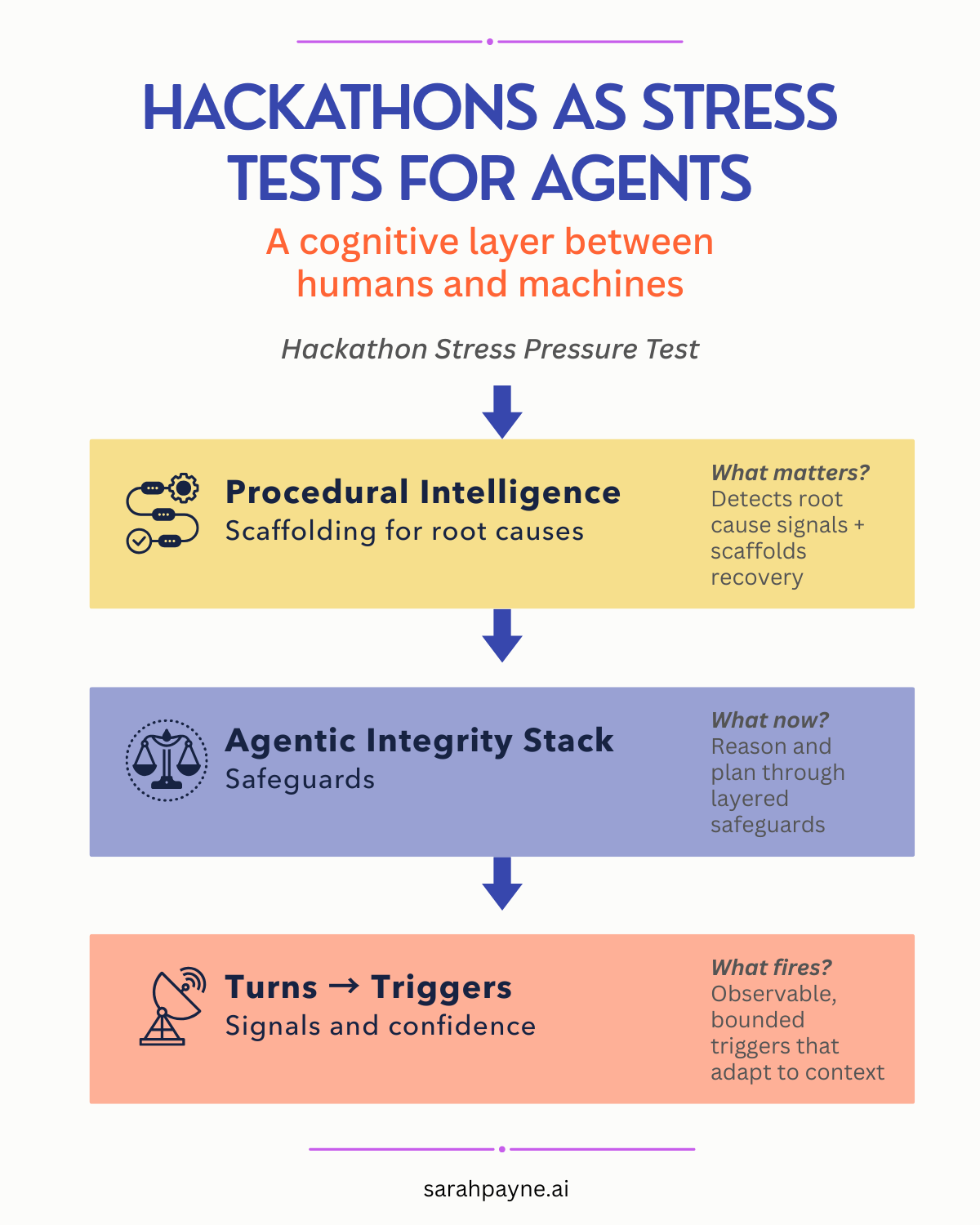
Procedural Intelligence → Scaffolding for Reasoning & Recovery
Compliance risks: Guardrails belong in tools and middleware, not only in prompts. If sensitive terms or placeholders can leak, the scaffolding is incomplete.
Missing/incorrect data: Per-step evaluation should validate outputs; placeholders should never reach customers.
Repeats/loops: Classic spiral logic – a planner retrying without new evidence. Cap how many times a plan can retry, and require new evidence before another attempt.
Agentic Integrity Stack → Layers of Trust
Compliance exposure: Points to weak data integrity and missing accountability. Observability and integrity checks should block restricted language before it surfaces.
Content mismatch/speculation or drift: A gap in logic integrity; the system wasn’t enforcing alignment with the source procedure. Arbitration should align responses to the procedure of record rather than allow loose matches.
From Turns to Triggers → Rethinking the Unit of Design
Procedures firing loosely: Signals weren’t bounded. Triggers must be observable, bounded, and composable to prevent over-firing.
Conversational quality: Turn-first design led to clarifying questions when a trigger (e.g. trigger the verified path or provide the exact next step) was needed.
Post-context handling: Triggers weren’t composable, so flows couldn’t inherit “already done” states.
Was This Agentic AI?
Not yet, and that’s part of the lesson. What we shipped was tool-calling orchestration with retrieval fallback. Useful, but not yet reasoning. The missing layer was the one that arbitrates options, evaluates outcomes, and recovers when steps fail. That’s the half-step many teams are in: orchestration that can mimic agency on the surface, until transcripts reveal it isn’t reasoning.
The Bigger Lesson
Hackathons don’t just launch features. They expose fault lines. The patterns surfaced (compliance, content, data, conversation, and triggering) are the same ones teams face when orchestration stands in for agency. The fix isn’t to slow down. It’s to scaffold, safeguard, and reframe:
Scaffolding (Procedural Intelligence): guardrails, fallback ladders, evaluation, observability.
Safeguards (Agentic Integrity Stack): overlapping integrity layers that hold trust when one layer cracks.
Signals (From Turns to Triggers): design units that are observable, bounded, and composable.
Reliability comes from layered frameworks that make autonomy an architectural property, not a quirk of model behavior.
Where This Leaves You
The gift of a hackathon is speed. The deeper gift is pressure, because it reveals the cracks before customers do. Use your next sprint or launch as a stress test and ask:
Where did compliance, content, or data crack first?
Were conversation failures about tone or about missing triggers?
Do you have the scaffolding, safeguards, and signals to design against these patterns before they scale?
That’s how prototypes turn into systems you can trust.
👋 Hey, I’m Sarah. I write about building AI systems that can reason, recover, and earn trust. I’m sharing frameworks in progress and testing how they land in real-world systems. If you’re exploring predictive autonomy or agentic workflows, I’d love to hear your perspective.
→ sarahpayne.ai for frameworks, visuals, and what’s coming next.