
Procedural Intelligence: How Agents Reason, Recover, and Verify in Runtime
The architecture that finally explains why “smart” agents still break

This essay is part of a 3-part trilogy on Procedural Intelligence, the core architecture that everything else I build sits on top of. This trilogy covers:
If you’re following along as these release, I recommend subscribing. Each chapter builds the cognitive foundation the rest of the Agentic Toolkit depends onand together, they form the backbone of how I design agentic systems.
There’s a moment in every agent program where the room goes quiet, because the system is confidently wrong and no one can quite explain why.
I’ve been in that moment more times than I want to admit. A demo sparkles; a workflow graph looks elegant; a model performs beautifully in isolation. Then production hits, and all the seams start to show… not in loud crashes, but in subtle drift.
And that was the first real clue: Agents don’t break loudly. They unravel.
You can refine prompts, layer conditional logic, expand tool use, and tighten flows and patch all the places that feel brittle and still watch the same failures reappear — not dramatically, but quietly enough that you only notice them once the damage has already spread:
silent loops
confident wrong actions
plans that quietly degrade
handoffs that drop context
“resolutions” that were never actually verified
As I kept rebuilding these systems, it became obvious that these failures weren’t tied to any specific org or stack. They were structural, the kind of symptoms that show up when something foundational is missing and no amount of prompt tuning can compensate for it.
Not an absence of intelligence.
An absence of architecture.
Why Procedural Intelligence Exists
Every agent system hides 3 quiet gaps:
1. The system doesn’t know what “success” actually means.
So it guesses. It optimizes for completion instead of correctness, which is how false positives slip through unnoticed.
2. The system can’t detect when its plan is degrading.
Confidence drops, a tool fails, context shifts. And yet the agent continues as if nothing has changed.
3. The system doesn’t know when to stop or escalate.
There’s no recovery contract, so the model improvises. It looks like a hallucination, but it’s structural.
These are architectural failures. Procedural Intelligence exists to close those gaps — giving agents a structured way to evaluate, gate, replan, verify, recover, and hand off in ways that are traceable instead of lucky.
What Procedural Intelligence Actually Is
At its core, Procedural Intelligence is an architectural layer:
above the model
below the surface
and wrapped around the agent
It carves out a disciplined pathway for decision-making:
Prediction → Reasoning → Action → Verification → Recovery
Instead of “model → tool,” PI turns agents into systems with:
logic blocks that mediate flow
execution modes that adapt under uncertainty
safeguards that prevent unsafe or premature decisions
evaluation layers that score behavior
observability loops that adjust thresholds over time
Procedural Intelligence gives the system a coherent thinking process, which is what lets all the moving parts evaluate state, make decisions, and correct course together instead of improvising alone.
The Architecture
Procedural Intelligence looks like a system because it is one.
The diagram below maps how an agent evaluates state, selects a mode, enforces safety rules, executes, verifies outcomes, and loops that behavior back into observability. It’s the first time many teams see agent reasoning laid out as an actual architecture, not an improvisation layer around a model.
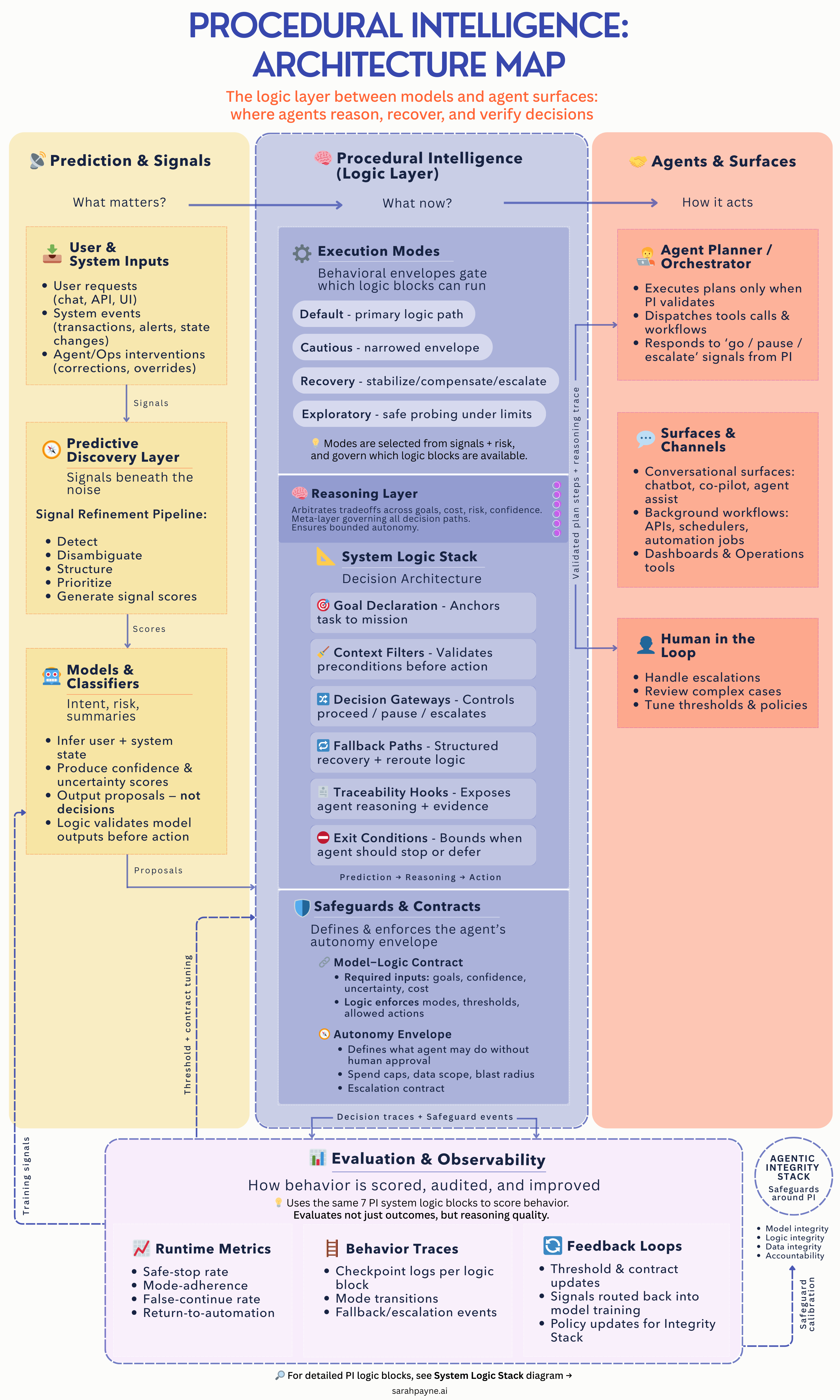
Key Elements of Procedural Intelligence
7 Logic Blocks — the cognitive skeleton of the system
Execution Modes — how agents adapt under risk
Model–Logic Interface — the seam where most silent failures live
Safeguards Layer — autonomy envelopes, constraints, verification rules
Verification + Evaluation Layer — runtime scoring of reasoning
Observability Loop — how behavior improves across cycles
Why This Architecture Matters
When you look closely at where agentic systems break, the pattern becomes painfully consistent: orchestration only gets you so far.
Reasoning beats orchestration because agents don’t need more steps; they need judgment. And fallbacks matter because escalation shouldn’t be the system’s first instinct but its final safety net. Recovery logic keeps the system from fracturing under pressure, and structure is what keeps trust from eroding one brittle decision at a time.
Autonomy collapses the moment constraint disappears. That’s why real reliability isn’t accidental; it’s built into the architecture.
A system can only be as agentic as its logic allows it to be.
Where This Leads Next
Procedural Intelligence creates the cognitive scaffolding to form the internal thinking patterns that make autonomy possible. But scaffolding alone isn’t enough. Agents also need trust infrastructure wrapped around that reasoning.
That’s where the Agentic Integrity Stack comes in.
The next article explores how the two interlock and why reliability, especially in 2025 and 2026, depends on treating them as one system rather than separate ideas.
👋 I’m Sarah. I write about building AI systems that can reason, recover, and earn trust. These frameworks aren’t final — they’re in motion, like the systems we build. If you’re seeing similar gaps in your own work, I’d love to hear what’s surfacing for you.
→ sarahpayne.ai for frameworks, visuals, and what’s coming next.